Spanish Constitution Day
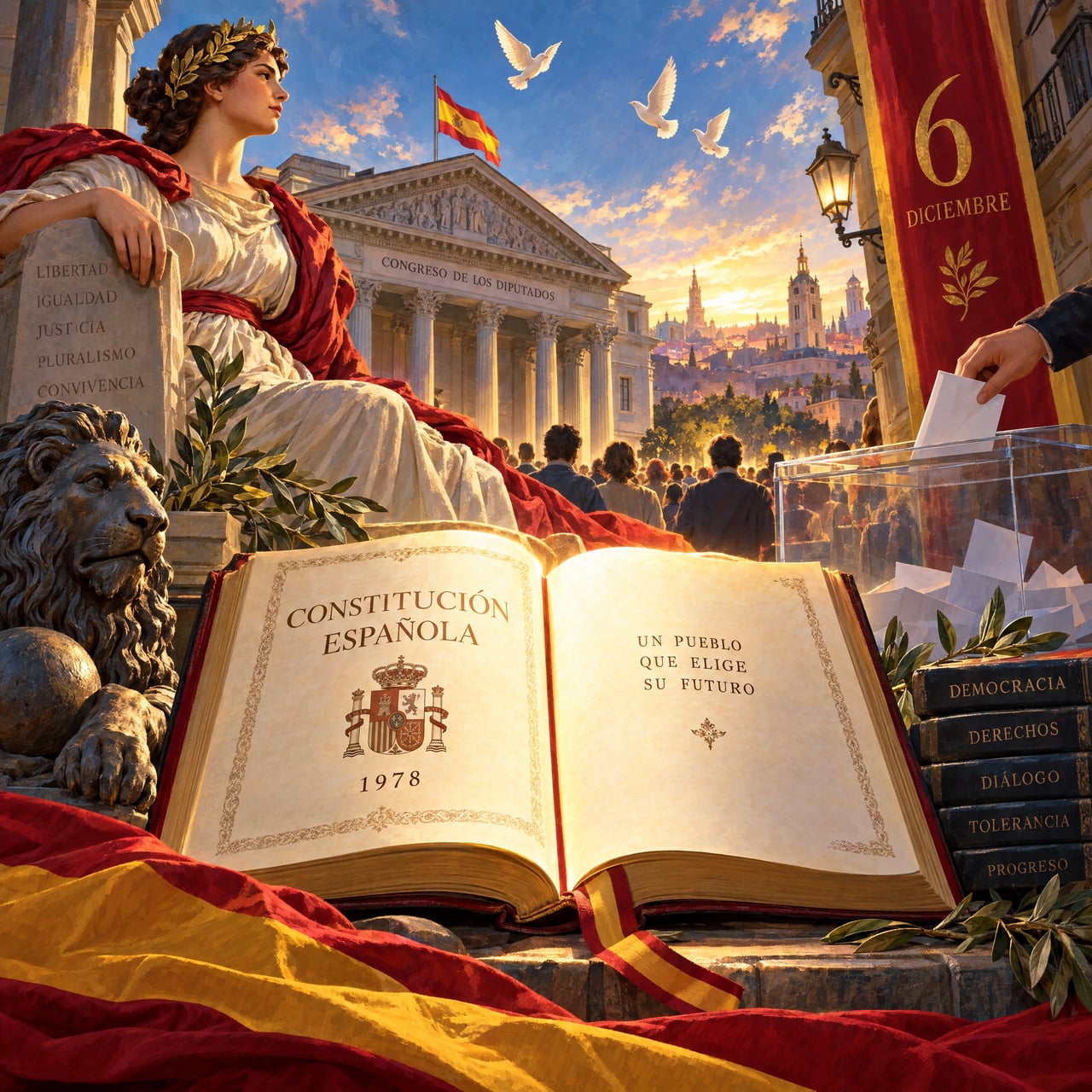
Spanish Constitution Day is celebrated every 6 December and recalls the 1978 referendum approval of the Constitution that underpins today's democratic order.
National holiday
6 December 2025
49,114,494
Verified data
Spanish Constitution Day in the working calendar
In 2025, Spanish Constitution Day is recorded as a national holiday on 6 December 2025. The calendars included in the dataset apply it in 19 regions and autonomous cities, covering 49,114,494 residents in the 2025 register.
This comparison uses only the official working calendars incorporated into the dataset for each year.
| Year | Main date | Where recorded | Residents |
|---|---|---|---|
| 2024 | 6 December 2024 | 19 regions and autonomous cities | 48,587,813 |
| 2025 | 6 December 2025 | 19 regions and autonomous cities | 49,114,494 |
| 2027 | 6 December 2027 | 19 regions and autonomous cities | 49,114,494 |
Demographic profile
Demographics of the covered population
Age, citizenship, birthplace and average-age structure from the 2025 Annual Population Census.
51% / 49%
12.9%
66.4%
20.7%
14.1%
19.3%
44.6 years
How it differs from its surroundings
Comparison with Spain. All five comparisons are population-weighted and use only the 2025 Annual Census. A positive sign means the covered population has a higher value than the benchmark.
| Demographic profile | Covered population | Compared with Spain |
|---|---|---|
| Aged 0–14 | 12.9% | 0 pp |
| Aged 65+ | 20.7% | 0 pp |
| Foreign citizenship | 14.1% | 0 pp |
| Born outside Spain | 19.3% | 0 pp |
| Weighted mean age | 44.6 years | 0 years |
The covered population matches Spain overall on these indicators.
Sex comes from the 2025 municipal register; all other metrics come from the 2025 Annual Census. Each percentage uses the total from its own statistical operation. INE municipal tables 68535 and 68541.
What is Spanish Constitution Day
On 6 December 1978 Spaniards ratified by referendum the constitutional text drafted by the Cortes after the Transition. The Constitution entered into force on 29 December that year and remains the fundamental law of the State: it organises powers, recognises rights and freedoms and articulates the State of Autonomies.
The date was established as a civic commemoration of the consensus that ended the dictatorship and opened the democratic period. It is not a religious or patron-saint feast, but an institutional milestone: schools, parliaments and town halls often schedule readings, ceremonies and flags to underline the value of the Magna Carta.
On the working calendar 6 December is a national holiday. When it falls on a Sunday, as in some years, certain communities move the day off to the following Monday; the meaning of the day, however, stays anchored to 6 December and the memory of the referendum.
Together with the Immaculate Conception on 8 December, the date often opens December's festive stretch. Its content is civic: remembering that democratic coexistence rests on an agreed text and on rights the calendar helps not to take for granted.
Other holidays
Per-municipality data with its official source (regional gazette). Every date is verifiable on the municipality page. Data from festivos.io — CC BY 4.0.