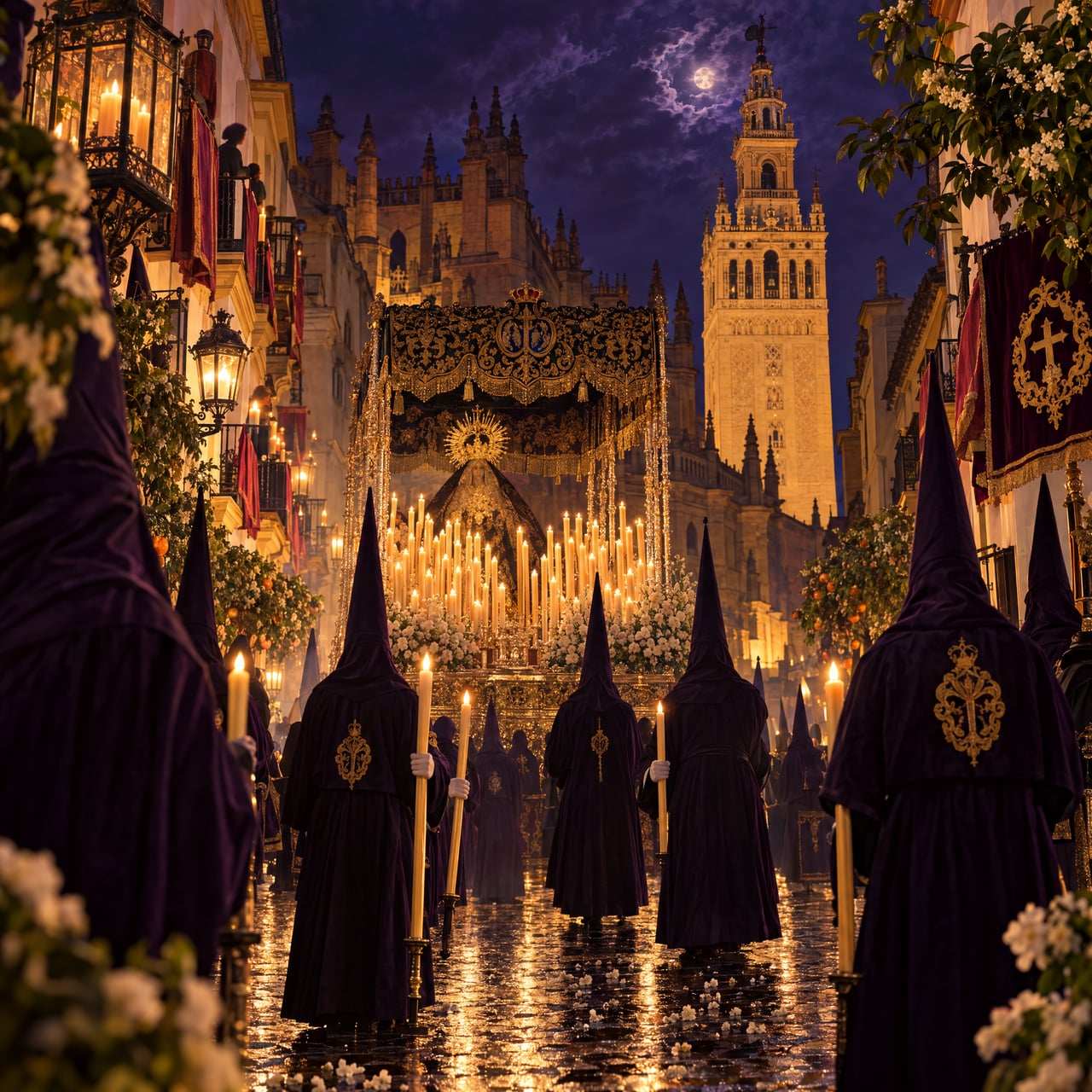
Maundy Thursday
Maundy Thursday is a Christian holiday with a movable date within Holy Week (March–April); in 2026 it falls on 2 April and is a public holiday in most autonomous communities, as well as Ceuta and Melilla.
Substitutable national holiday
2 April 2026
35,552,386
The Official State Gazette lists it as a substitutable national holiday: each community decides whether to keep or replace it. In 2026 it is a holiday in: Andalucía, Aragón, Canarias, Cantabria, Castilla y León, Castilla-La Mancha, Ceuta, Comunidad de Madrid, Comunidad Foral de Navarra, Extremadura, Galicia, Illes Balears, La Rioja, Melilla, País Vasco, Principado de Asturias and Región de Murcia.
Verified data
Maundy Thursday in the working calendar
In 2026, Maundy Thursday is recorded as a substitutable national holiday on 2 April 2026. The calendars included in the dataset apply it in 17 regions and autonomous cities; and a local holiday in Comunitat Valenciana (11 municipalities) and Cataluña (2 municipalities), covering 35,657,025 residents in the 2025 register.
This comparison uses only the official working calendars incorporated into the dataset for each year.
| Year | Main date | Where recorded | Residents |
|---|---|---|---|
| 2024 | 28 March 2024 | 17 regions and autonomous cities; and a local holiday in Comunitat Valenciana (7 municipalities) | 35,409,024 |
| 2025 | 17 April 2025 | 17 regions and autonomous cities; and a local holiday in Comunitat Valenciana (3 municipalities) | 35,608,621 |
| 2026 | 2 April 2026 | 17 regions and autonomous cities; and a local holiday in Comunitat Valenciana (11 municipalities) and Cataluña (2 municipalities) | 35,657,025 |
Demographic profile
Demographics of the covered population
Age, citizenship, birthplace and average-age structure from the 2025 Annual Population Census.
51.1% / 48.9%
12.8%
66.2%
21%
12.2%
17.2%
44.8 years
How it differs from its surroundings
Comparison with Spain. All five comparisons are population-weighted and use only the 2025 Annual Census. A positive sign means the covered population has a higher value than the benchmark.
| Demographic profile | Covered population | Compared with Spain |
|---|---|---|
| Aged 0–14 | 12.8% | -0.1 pp |
| Aged 65+ | 21% | +0.3 pp |
| Foreign citizenship | 12.2% | -1.9 pp |
| Born outside Spain | 17.2% | -2.1 pp |
| Weighted mean age | 44.8 years | +0.2 years |
The largest difference from Spain is in “Born outside Spain”: -2.1 pp.
Sex comes from the 2025 municipal register; all other metrics come from the 2025 Annual Census. Each percentage uses the total from its own statistical operation. INE municipal tables 68535 and 68541.
What is Maundy Thursday
Maundy Thursday commemorates the Last Supper of Jesus with his disciples and begins the Easter Triduum, the central period of Holy Week. Catholic tradition associates three ideas with this day: the institution of the Eucharist, the priesthood and the commandment of brotherly love. Another characteristic image is the washing of the feet, in which Jesus washes the feet of his disciples as a gesture of humility and service.
Its date is not fixed: it depends on the Christian liturgical calendar and the date of Easter, so Holy Week moves between the end of March and mid-April depending on the year. Holy Week was declared Intangible Cultural Heritage of Spain in 2017; The Ministry of Culture highlights that it commemorates the Passion, death and resurrection of Jesus Christ through a great diversity of celebrations, especially processions.
Maundy Thursday is experienced in very different ways depending on the territory, with processions that alternate silence, band music or the sound of drums. Among its best-known manifestations are La Madrugá in Seville, which takes place between the night of Maundy Thursday and the morning of Good Friday, and the transfer of the Christ of the Good Death, or Christ of Mena, accompanied by the Legion in Malaga.
In 2026 it is a holiday in Andalusia, Aragon, Asturias, the Balearic Islands, the Canary Islands, Cantabria, Castilla-La Mancha, Castilla and León, Extremadura, Galicia, the Community of Madrid, the Region of Murcia, the Foral Community of Navarra, the Basque Country, La Rioja, Ceuta and Melilla. The BOE includes it as a national holiday with respect to which these communities and cities have not exercised the power of substitution.
Other holidays
Per-municipality data with its official source (regional gazette). Every date is verifiable on the municipality page. Data from festivos.io — CC BY 4.0.