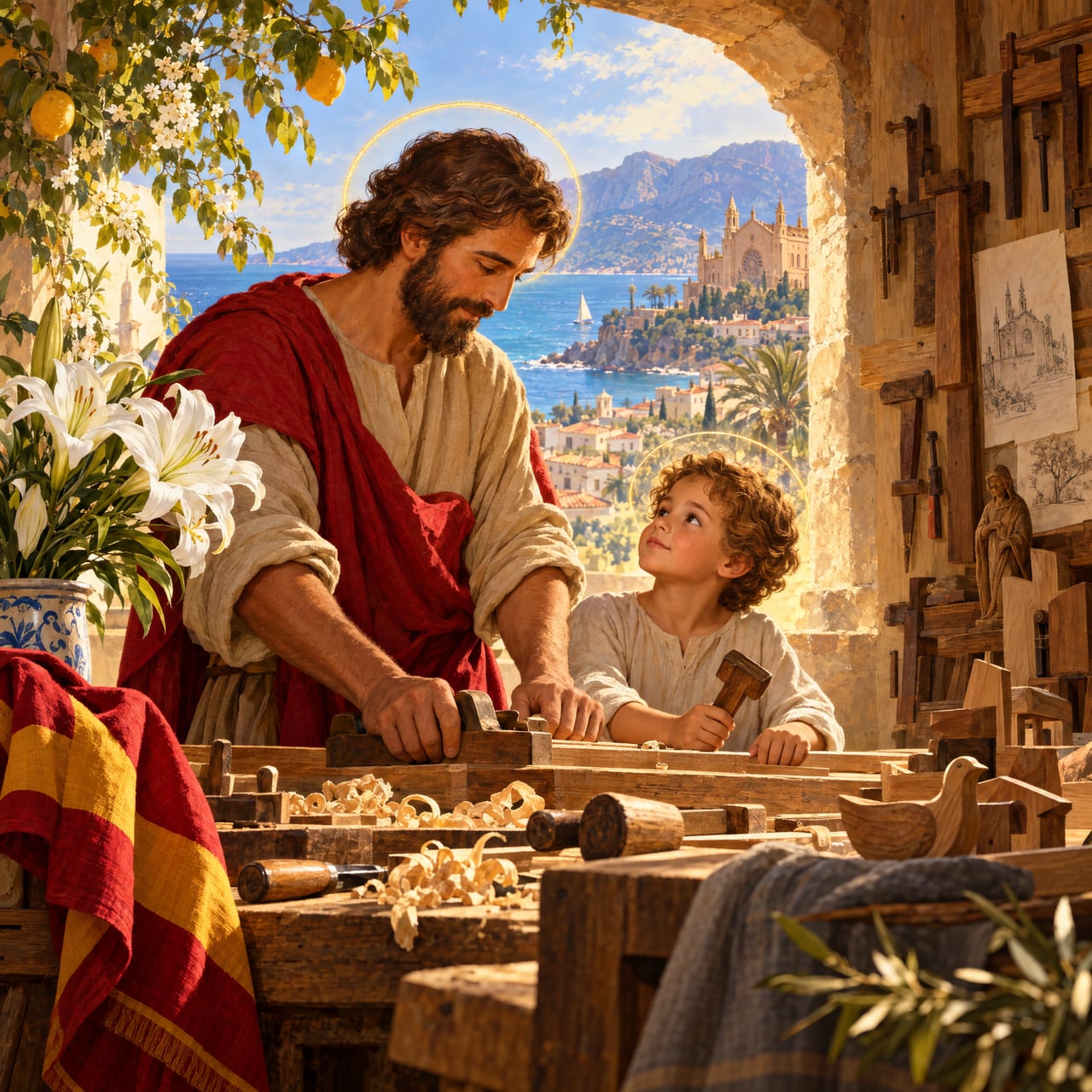
Saint Joseph's Day
Saint Joseph, husband of Mary and father of Jesus in the Christian tradition, is celebrated every 19 March. The Official State Gazette lists it as a substitutable national holiday; in 2026 it is a public holiday in Galicia, the Region of Murcia, the Foral Community of Navarra, the Basque Country and the Valencian Community.
Substitutable national holiday
19 March 2026
12,643,992
The Official State Gazette lists it as a substitutable national holiday: each community decides whether to keep or replace it. In 2026 it is a holiday in: Comunidad Foral de Navarra, Comunitat Valenciana, Galicia, País Vasco and Región de Murcia.
Verified data
Saint Joseph's Day in the working calendar
In 2026, Saint Joseph's Day is recorded as a substitutable national holiday on 19 March 2026. The calendars included in the dataset apply it in Comunidad Foral de Navarra, Comunitat Valenciana, Galicia, País Vasco and Región de Murcia; and a local holiday in Andalucía (9 municipalities), Cataluña (9 municipalities), Castilla-La Mancha (8 municipalities), Castilla y León (6 municipalities), Extremadura (5 municipalities), Aragón (4 municipalities), Cantabria (1 municipalities), Comunidad de Madrid (1 municipalities) and La Rioja (1 municipalities), covering 12,852,291 residents in the 2025 register.
This comparison uses only the official working calendars incorporated into the dataset for each year.
| Year | Main date | Where recorded | Residents |
|---|---|---|---|
| 2024 | 19 March 2024 | Comunitat Valenciana and Región de Murcia; and a local holiday in Extremadura (5 municipalities), Castilla y León (4 municipalities), Cataluña (2 municipalities), Andalucía (1 municipalities), Cantabria (1 municipalities), La Rioja (1 municipalities) and País Vasco (1 municipalities) | 7,153,279 |
| 2025 | 19 March 2025 | Comunitat Valenciana and Región de Murcia; and a local holiday in Castilla y León (5 municipalities), Extremadura (5 municipalities), Andalucía (3 municipalities), Castilla-La Mancha (2 municipalities), Cataluña (2 municipalities), Cantabria (1 municipalities), Comunidad de Madrid (1 municipalities), Illes Balears (1 municipalities), País Vasco (1 municipalities) and Principado de Asturias (1 municipalities) | 7,223,234 |
| 2026 | 19 March 2026 | Comunidad Foral de Navarra, Comunitat Valenciana, Galicia, País Vasco and Región de Murcia; and a local holiday in Andalucía (9 municipalities), Cataluña (9 municipalities), Castilla-La Mancha (8 municipalities), Castilla y León (6 municipalities), Extremadura (5 municipalities), Aragón (4 municipalities), Cantabria (1 municipalities), Comunidad de Madrid (1 municipalities) and La Rioja (1 municipalities) | 12,852,291 |
Demographic profile
Demographics of the covered population
Age, citizenship, birthplace and average-age structure from the 2025 Annual Population Census.
51% / 49%
12.8%
65.2%
22.1%
14.2%
19.1%
45.3 years
How it differs from its surroundings
Comparison with Spain. All five comparisons are population-weighted and use only the 2025 Annual Census. A positive sign means the covered population has a higher value than the benchmark.
| Demographic profile | Covered population | Compared with Spain |
|---|---|---|
| Aged 0–14 | 12.8% | -0.1 pp |
| Aged 65+ | 22.1% | +1.3 pp |
| Foreign citizenship | 14.2% | +0.2 pp |
| Born outside Spain | 19.1% | -0.1 pp |
| Weighted mean age | 45.3 years | +0.7 years |
The largest difference from Spain is in “Aged 65+”: +1.3 pp.
Sex comes from the 2025 municipal register; all other metrics come from the 2025 Annual Census. Each percentage uses the total from its own statistical operation. INE municipal tables 68535 and 68541.
What is Saint Joseph's Day
The festival has an ancient origin: the first Western references to the cult of Saint Joseph linked to this date appear around the year 800 in northern France. The holiday began to be officially celebrated on 19 March in 1480 and became obligatory for the Catholic Church in 1621. Saint Joseph is not a protagonist figure in the stories, but his role is fundamental as husband of Mary and earthly father of Jesus.
19 March is also Father's Day in Spain. Its modern origin is attributed to the teacher Manuela Vicente Ferrero, who in 1948 organized a day in a school in Vallecas to honor parents; That school initiative ended up becoming a national tradition.
The festival is experienced differently depending on the territory. In Galicia, Murcia, Navarra and the Basque Country it has a family and religious character. In the Valencian Community it coincides with the end of the Fallas of Valencia: the night of 19 March the cremà is celebrated, when the Fallas monuments burn. The fallera tradition is linked to the ancient Valencian carpenters, who burned remains of wood when spring arrived coinciding with their patron's festival. Las Fallas are recognized by UNESCO as Intangible Cultural Heritage of Humanity.
Saint Joseph, patron saint of carpenters and the universal Church.
Other holidays
Per-municipality data with its official source (regional gazette). Every date is verifiable on the municipality page. Data from festivos.io — CC BY 4.0.