New Year's Day
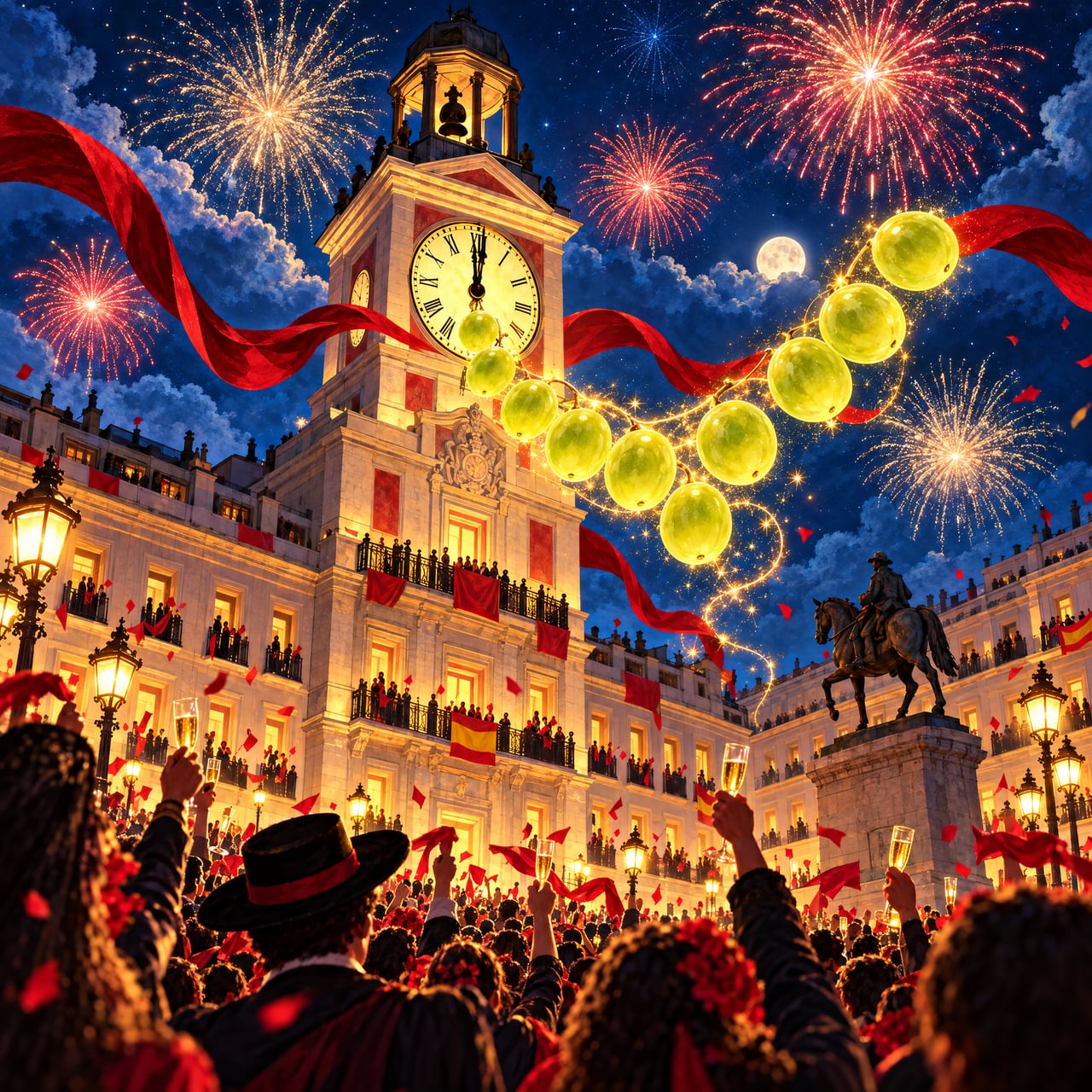
New Year's Day falls every 1 January: it closes New Year's Eve with the Twelve Grapes and opens the civil calendar across Spain.
National holiday
1 January 2026
49,114,494
Verified data
New Year's Day in the working calendar
In 2026, New Year's Day is recorded as a national holiday on 1 January 2026. The calendars included in the dataset apply it in 19 regions and autonomous cities, covering 49,114,494 residents in the 2025 register.
This comparison uses only the official working calendars incorporated into the dataset for each year.
| Year | Main date | Where recorded | Residents |
|---|---|---|---|
| 2024 | 1 January 2024 | 19 regions and autonomous cities | 48,587,813 |
| 2025 | 1 January 2025 | 19 regions and autonomous cities | 49,114,494 |
| 2026 | 1 January 2026 | 19 regions and autonomous cities | 49,114,494 |
Demographic profile
Demographics of the covered population
Age, citizenship, birthplace and average-age structure from the 2025 Annual Population Census.
51% / 49%
12.9%
66.4%
20.7%
14.1%
19.3%
44.6 years
How it differs from its surroundings
Comparison with Spain. All five comparisons are population-weighted and use only the 2025 Annual Census. A positive sign means the covered population has a higher value than the benchmark.
| Demographic profile | Covered population | Compared with Spain |
|---|---|---|
| Aged 0–14 | 12.9% | 0 pp |
| Aged 65+ | 20.7% | 0 pp |
| Foreign citizenship | 14.1% | 0 pp |
| Born outside Spain | 19.3% | 0 pp |
| Weighted mean age | 44.6 years | 0 years |
The covered population matches Spain overall on these indicators.
Sex comes from the 2025 municipal register; all other metrics come from the 2025 Annual Census. Each percentage uses the total from its own statistical operation. INE municipal tables 68535 and 68541.
What is New Year's Day
1 January marks the beginning of the year in the Gregorian calendar, the same one that governs administrative, school and working life. In Spain it is one of the most recognisable civil holidays on the calendar: it does not commemorate a saint or a biblical episode, but the symbolic passage from one year to the next.
The eve, New Year's Eve (Nochevieja), concentrates much of the popular ritual. At midnight many families eat the twelve grapes to the chime of the clock; the best-known image is Madrid's Puerta del Sol, broadcast every year, though the custom is also lived in homes, squares and parties across the country. The grapes became popular in the early twentieth century and ended up as the collective gesture of the New Year.
After midnight come toasts, hugs, fireworks and wishes of prosperity. 1 January itself is usually quieter: family meals, phone calls and, in many cities, walks or light cultural events. It closes the end-of-year festive cycle that begins with Christmas and runs through to Epiphany.
As a fixed date on the civil calendar, New Year's Day has a secular, shared tone. Sitting alongside Christmas and Three Kings' Day in the same winter stretch reinforces its role as a threshold: the day for looking ahead after December's domestic celebrations.
Other holidays
Per-municipality data with its official source (regional gazette). Every date is verifiable on the municipality page. Data from festivos.io — CC BY 4.0.