Epiphany
Epiphany — Three Kings' Day — is celebrated every 6 January: it closes Christmas with the parade, the Roscón and the Magi's gifts.
National holiday
6 January 2026
49,114,494
Verified data
Epiphany in the working calendar
In 2026, Epiphany is recorded as a national holiday on 6 January 2026. The calendars included in the dataset apply it in 19 regions and autonomous cities, covering 49,114,494 residents in the 2025 register.
This comparison uses only the official working calendars incorporated into the dataset for each year.
| Year | Main date | Where recorded | Residents |
|---|---|---|---|
| 2024 | 6 January 2024 | 19 regions and autonomous cities | 48,587,813 |
| 2025 | 6 January 2025 | 19 regions and autonomous cities | 49,114,494 |
| 2026 | 6 January 2026 | 19 regions and autonomous cities | 49,114,494 |
Demographic profile
Demographics of the covered population
Age, citizenship, birthplace and average-age structure from the 2025 Annual Population Census.
51% / 49%
12.9%
66.4%
20.7%
14.1%
19.3%
44.6 years
How it differs from its surroundings
Comparison with Spain. All five comparisons are population-weighted and use only the 2025 Annual Census. A positive sign means the covered population has a higher value than the benchmark.
| Demographic profile | Covered population | Compared with Spain |
|---|---|---|
| Aged 0–14 | 12.9% | 0 pp |
| Aged 65+ | 20.7% | 0 pp |
| Foreign citizenship | 14.1% | 0 pp |
| Born outside Spain | 19.3% | 0 pp |
| Weighted mean age | 44.6 years | 0 years |
The covered population matches Spain overall on these indicators.
Sex comes from the 2025 municipal register; all other metrics come from the 2025 Annual Census. Each percentage uses the total from its own statistical operation. INE municipal tables 68535 and 68541.
What is Epiphany
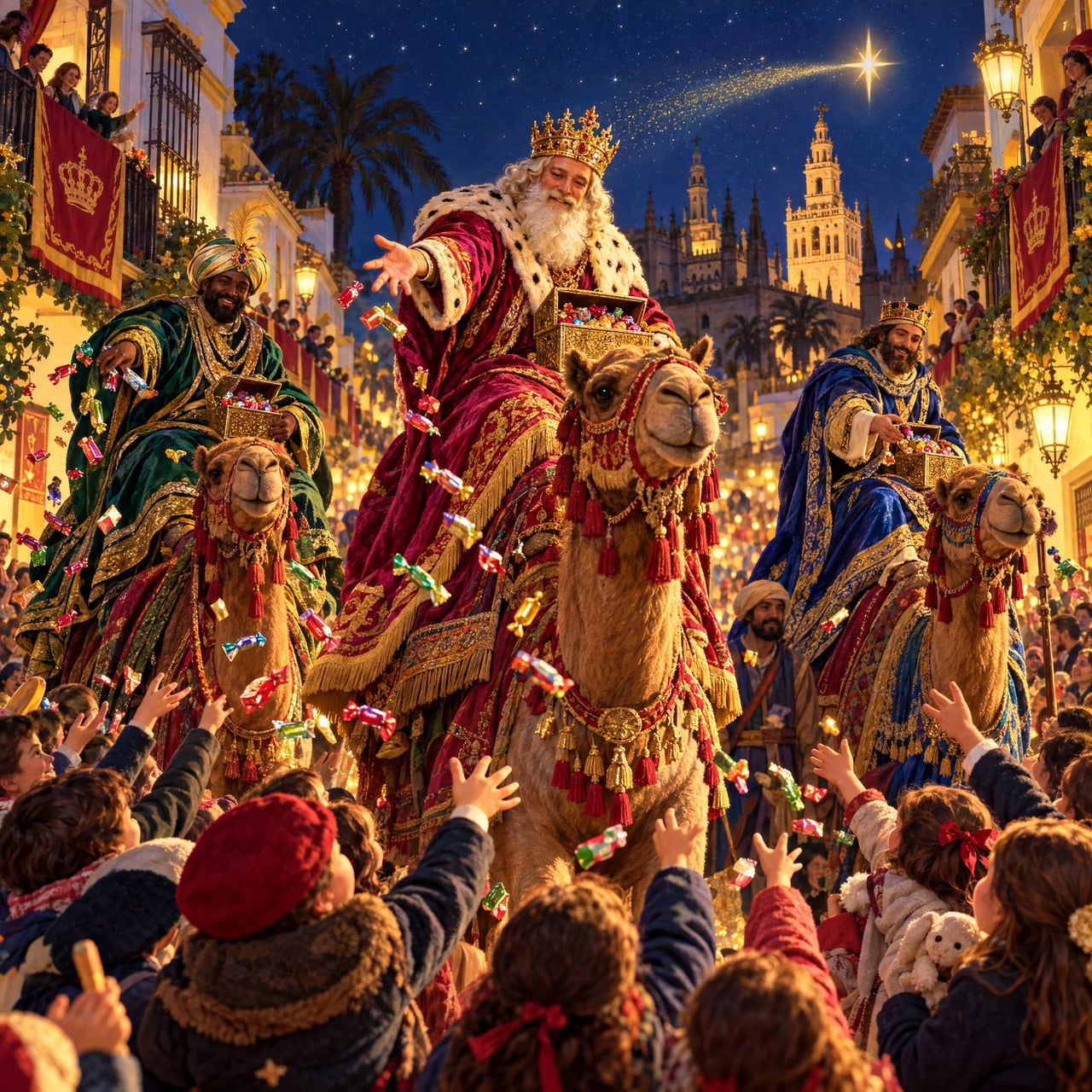
6 January commemorates, in Western Christian tradition, the adoration of the Magi from the East to the infant Jesus: the manifestation (epiphany) of Christ to the peoples. In Spain the feast is best known as Three Kings' Day and closes the Christmas cycle that begins on 25 December.
On the eve, 5 January, many localities organise the Three Kings' parade: floats, sweets and the public arrival of Melchior, Caspar and Balthazar. At home, the tradition of leaving shoes or stockings and writing a letter to the Kings remains the great childhood rite of winter, often more rooted here than Santa Claus in many families.
The Roscón de Reyes — a ring-shaped bun decorated with candied fruit, often filled with cream — accompanies breakfast or afternoon tea. Inside there is usually a bean or a small figurine: whoever finds it, by local custom, pays for the cake or is crowned for a day. It is a festive gesture shared in homes and bakeries across the country.
Beyond the liturgical calendar, Three Kings' Day works as a family day of gifts, visits and long meals. It marks the symbolic end of the winter holidays before the return to January's ordinary rhythm.
Other holidays
Per-municipality data with its official source (regional gazette). Every date is verifiable on the municipality page. Data from festivos.io — CC BY 4.0.